Are You Ready for Your Restaurant Brand to Expand? Here is The Why, When and How.
Updated: Oct 6, 2025
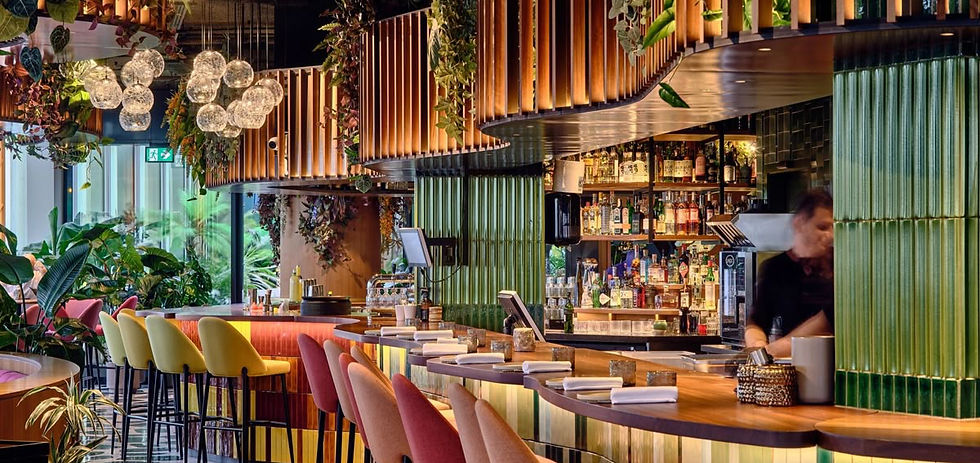
Opening a restaurant, bar, or coffeeshop is one achievement. Scaling it into multiple outlets—or even a regional or global brand—is another challenge entirely. Many F&B concepts succeed locally but fail when it comes to expansion because they were not structured with growth in mind from the start. The difference between a one-off restaurant and a scalable venture lies in foresight, planning, adaptation, and execution.
We have listed some critical elements to consider when setting your restaurant up for future expansion.
1. Investment Management: Building the Right Foundation
Scaling requires capital, and how you manage your investment from day one determines your capacity for growth. Expansion-ready ventures:
Allocate your funds wisely between CapEx (equipment, design, fit-out) and OpEx (operations, marketing, payroll).
Avoid over-leveraging in the first location—high debt cripples flexibility. Remember that every dollar you spend on premium materials will take longer to reach ROI, especially if the additional investment does not reflect in added value.
Set aside reserves for reinvestment, rather than relying solely on external funding later.
Establish a clear ROI model to demonstrate profitability to investors or potential franchisees.
Strong financial discipline builds trust and provides the capital runway needed for growth.
2. Team Selection: People Drive Expansion

A scalable restaurant is powered by a team that can replicate success. Expansion requires more than a talented chef—it needs a leadership pipeline in order to manage further openings, potentially multiple concurrently. Therefore, as a business owner, you need to consider:
Hiring managers with multi-unit or brand experience.
Creating structured training programs to develop leaders and manager to ensure consistency across outlets.
Building a culture of accountability that aligns with the business’ long-term goals.
Designing an organizational chart for scale, not just for a single unit.
Looking for individuals with the same ambition and mindset as yourself: people that are driven by expansion, excellence, multi-tasking and understand that their leadership role is not a 9-to-5 position.
The right team ensures your concept doesn’t dilute as you grow.
"Scaling should be data-driven, not ego-driven"
3. Operating Standards and Processes: Consistency is Non-Negotiable
Expansion is impossible without standardized operating procedures. A second or third unit should feel like the first—no matter the city or country. Create detailed SOPs for:
Recipe preparation and portion sizes
Guest service protocols
Supply chain and vendor management
Marketing brand guidelines
Hygiene, health, and safety practices
Flowcharts for various processes pertaining to Finance, HR, Operations, Decision Making
Documented standards and processes form the backbone of quality control and brand integrity.

4. Technology Innovation: Building Smart Infrastructure
Once you start expanding your business into multiples, it is no longer feasible to manage your operations with Excell sheets and memos written “on the back of a packet of cigarettes…”. Technology is not a luxury—it is the engine of scale.
Future-ready restaurants have no other option but to integrate:
Cloud-based POS systems that centralize data across outlets
Inventory and procurement software for real-time cost management
Accounting software, or an ERP, to keep accurate track of revenues, costs, assets, balance sheets, creditors, debtors, payments, etc…
Customer relationship management (CRM) platforms for loyalty and personalization
AI-driven forecasting tools for payroll scheduling and sales predictions
Technology makes scaling smoother by reducing inefficiencies and providing data-driven insights.
5. Realistic Business Plan: Setting Expansion Milestones (also see our previous blog on the topic of business plans)
A dream of 50 outlets is meaningless without a realistic plan. Expansion-ready business plans should therefore include:
Growth milestones (e.g., second unit within 18 months, third within 36 months). This phase needs to be linked to recruitment to ensure you have the leadership in place to execute the planned expansion.
Market prioritization: Which cities or regions offer the best ROI? Will you stay local / regional, or will you target international destinations? If so, one has to be familiar with the legal ramifications in the various countries that are on the radar for expansion.
Capital requirements and financing strategies: are you able to fund this yourself, do you need outside investment, how much of your equity are you willing to sacrifice for an investor, are there any government schemes you can apply for to receive financial support, etc…
Exit or scaling strategies (franchise, joint venture, management contract, full ownership). If you choose to walk into the world of franchising, then you will need to research the pitfalls and the legal framework before you can activate.
A realistic plan balances ambition with pragmatism,
6. Timing: Expanding at the Right Pace

This is my favourite topic to talk about; over the many years we have been assisting private clients in the set-up of their F&B venture, some of them were discussing expansion of the brand already during our first introductory meeting. In principle, this can be seen as positive ambition, however some of them already had a roadmap and a financial model ready BEFORE they had actually worked on developing their concept. So here is the golden rule for timing your next outlet: no matter how much cash you hold, how perfect your financial model looks, how ambitious you are, or how much you believe you have found the gap in the market, your next outlet will only work if:
· your first outlet is up and running
· you have your SOP’s and processes all nailed down to a “T”
· you have a team in place to support the expansion
· your current outlet has stable profitability
· the customer demand is still growing
· you are building brand equity with your first outlet
Expanding too soon can be as dangerous as not expanding at all. But you need to have something tangible in hand to avoid costly mistakes and disappointment. Scaling should be data-driven, not ego-driven.
"Relevance is key—yesterday’s menu won’t guarantee tomorrow’s success"
7. Location, Location, Location
The success of a restaurant expansion often hinges on choosing the right location. Footfall, demographics, competition, and accessibility all matter. A location strategy for growth will be determined by:
Defining a customer profile and target neighbourhoods; are you looking at a residential area, an office area, a busy mall? All the aforementioned have different demographics, different spending power, and a different revenue model.
Using heat maps and real estate analytics to identify opportunities.
Balancing flagship locations (high visibility, high cost) with satellite units (lower cost, local reach).
Expansion requires discipline: not every available lease unit is the right fit for your brand and walking away can sometimes be the best decision you can take at that moment.

8. Partnerships: Leveraging Strategic Alliances
No brand expands alone, especially if your product has particular specifications (i.e. a burger concept, a bakery, pizza, …). Partnerships can accelerate growth by sharing resources and risks.
You need to consider:
Supplier partnerships for favourable terms and detailed product specs as volume grows.
Marketing collaborations with lifestyle brands or delivery platforms.
Real estate partnerships with malls, airports, or hotel groups.
Strategic alliances extend reach and provide credibility in new markets, especially those where a partner is much stronger.
9. Franchising vs. Management Contract vs. Joint Venture vs. Full Ownership
The model you choose for expansion defines your risk-reward profile:
Franchising: Fast growth with limited capital outlay, but less control over execution. Ownership bears the investment risk.
Management Contracts: Brand provides expertise, systems, and management support; ownership bears investment risk.
Joint Ventures: Shared investment and operational responsibilities—good for entering unfamiliar markets. Trust is the most important aspect in this type of collaboration.
Full Ownership: Maximum control and profit, but also maximum risk and capital requirement.
Choosing the right model depends on your financial position, brand strength, appetite for risk and growth vision.
10. Trend Watching and Product Relevance

Restaurants that expand successfully evolve with consumer trends without losing their core identity. This means:
Monitoring shifts in dietary preferences (plant-based, gluten-free, functional foods)
Adapting to delivery-first dining while maintaining dine-in appeal
Experimenting with new formats (food halls, pop-ups, digital kitchens)
Cultural adaptation depending on the destination; when Mc Donalds went to Asia, their success was not imminent. It was only when the company introduced rice dishes to the menu, that it became the success it is today. The general rule is, that your menu should be 70% fixed and 30% adaptable to the local culture / flavours / guest expectations. In the Middle East, many franchises have failed over the years due to their inflexibility in adapting to the target demographic.
Relevance is key—yesterday’s menu won’t guarantee tomorrow’s success.
11. Exit Strategy: Planning Beyond Expansion
An expansion plan must also outline a potential exit strategy for investors or owners. Options include:
Selling your brand to a larger group
IPO or private equity involvement
Transitioning to a pure franchising model
Passing ownership to a new management team
Clarity on exits reassures investors and gives direction to long-term strategy.
Some Final Thoughts…
A restaurant’s first location may win hearts, but expansion requires far more than a good menu. To set your venture up for future growth, you must manage your investments wisely, hire the right team, establish strict operating standards and processes, embrace technology, and create a realistic, scalable business plan without damaging your current operations or breaking the bank purely to satisfy your own ego.
Expansion is not about chasing numbers—it is about building a sustainable brand that can replicate its success across markets. By balancing ambition with discipline, your restaurant business can grow from a single outlet into a trusted name that endures for decades.
Those that have been successful in multiplying their brand will tell you that the entire experience is lots of hard work and a lot of sacrifice in your private life. However, when it’s done sensibly with the right team behind you, the financial rewards upon exit are worthwhile.
· RBnH Solutions is an established food and beverage consultant, based in the UAE, with on the ground experience in 5 continents. Are you looking for an F&B consultant to advise you on your operational model, restructuring, expansion and franchise, F&B strategy, or concept implementation, give us a call for an initial discussion how we can contribute to the success of your business.


Comments